
Yes, you can sell a house with a mortgage, and it’s far more straightforward than most people expect. The majority of homeowners selling up still have an outstanding balance to clear. That balance doesn’t block the sale; it’s simply settled from the proceeds when the transaction completes. What you really need to get your head around is what happens to that money, where the costs come from, and what you’ll have left once everything is paid.
This guide walks through the full process: from mortgage redemption to equity calculations, early repayment charges, and what to consider if you’re mid-fix or thinking about taking your deal to a new property.
What Happens to Your Mortgage When You Sell?
Your mortgage doesn’t get handed over to the buyer or quietly written off. It’s repaid in full on completion day. Here’s what that looks like in practice.
Once a sale is agreed, your conveyancer writes to your lender requesting a mortgage redemption statement. This sets out the precise amount needed to clear the debt on a given date: the outstanding capital, daily interest to that point, and any fees the lender applies.
On the day of completion, the buyer’s money lands in your conveyancer’s client account. Before anything reaches you, the mortgage is cleared directly from those funds. What’s left after legal costs and estate agent fees gets transferred across to you. Simultaneously, the lender releases their legal charge from the title at HML and Registry, and the property legally becomes the buyer’s. The whole thing, repayment, discharge, and transfer, is tied together in one day.
Your conveyancer handles all of this coordination. Your job is to make sure you understand the financial outcome before you agree on a sale price, not after.
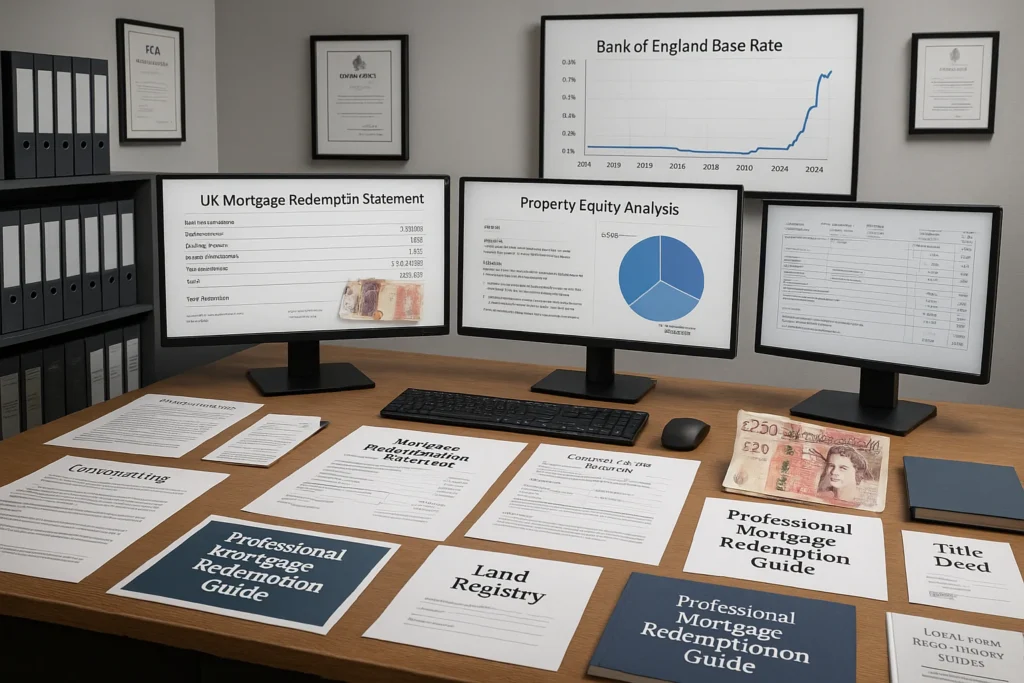
What Will You Actually Walk Away With?
Most guides gloss over this, but it’s the number that actually matters. Here’s how to work it out.
Sale price minus:
- Outstanding mortgage balance
- Early repayment charges (if applicable)
- Estate agent fees (typically 1%–3% of sale price)
- Conveyancing fees (typically £1,000–£2,000 for a sale)
- Any other secured loans or charges on the property
= Your net proceeds
Example (illustrative figures):
| Item | Amount |
| Sale price | £320,000 |
| Outstanding mortgage | £190,000 |
| Early repayment charge (1.5%) | £2,850 |
| Estate agent fee (1.5%) | £4,800 |
| Conveyancing fees | £1,200 |
| Net proceeds | £121,150 |
Your actual figures will differ, but running this calculation before you go to market is far more useful than doing it after you’ve shaken hands on a price. Sellers who skip this step sometimes find the numbers less comfortable than they’d assumed.
Selling a House During a Fixed-Term Mortgage: What You Need to Know
This is the area where costs can catch people off guard. Repaying a mortgage before the fixed-rate period ends, which is exactly what selling a mortgaged property involves, usually triggers an early repayment charge (ERC).
Lenders calculate ERCs as a percentage of your remaining mortgage balance, and the charge typically steps down year by year. Here’s a typical structure:
Year of Fixed Term , Typical ERC
| Year of Fixed Term | Typical ERC |
| Year 1 | 5% |
| Year 2 | 4% |
| Year 3 | 3% |
| Year 4 | 2% |
| Year 5 | 1% |
| After fixed term ends | 0% |
The exact rates depend on your lender and your specific product, so check your original mortgage offer or call your lender directly before making any assumptions.
To put it in real terms: on a £200,000 balance with a 3% ERC, you’re looking at a £6,000 charge. That’s money straight off your net proceeds, which is why plenty of homeowners either plan their sale around the end of their fixed term or look at porting their mortgage across to a new property instead.
Porting vs Redeeming: What’s the Difference?
If you’re selling and buying at the same time, redeeming your mortgage isn’t necessarily your only option. Many lenders offer portable deals, which let you carry your existing mortgage across to a new property rather than clearing it entirely.
| Porting | Redeeming | |
| What happens | Existing mortgage moves to new property | Mortgage is repaid in full on completion |
| ERC | Usually avoided | Charged if within fixed-rate period |
| Lender approval needed | Yes, they reassess affordability | No |
| Borrowing more | Possible, but new rate applies to extra | You choose entirely new deal |
| Flexibility | Limited by existing terms | Full freedom to remortgage elsewhere |
Porting can look like an easy win on paper, but it’s conditional. Your lender will run a fresh affordability assessment based on their current criteria, which may be stricter than when you first applied. If they decline, you’re back to redeeming and facing ERCs regardless. Don’t assume porting will be approved; get mortgage advice first and know your fallback position.
What Is a Mortgage Redemption Statement?
When selling a mortgaged property, the redemption statement is the document that makes the financial side of completion possible. Your lender issues it to confirm the exact sum required to clear your mortgage on a specific date, covering the capital balance, interest accrued to that day, and any applicable charges.
Because interest runs daily, the figure shifts each day. Most redemption statements carry a validity window of around 30 days. If completion slips beyond that, your conveyancer will go back to the lender for a revised figure. This is standard practice and nothing to worry about.
Your conveyancer requests this on your behalf once you have an accepted offer and a likely completion date to work towards.

Dealing with Negative Equity
Negative equity occurs when your mortgage balance is higher than what the property will sell for; it is less prevalent now than during previous market downturns. Still, it remains a reality for some homeowners. It tends to affect those who bought near a price peak, took out a high loan-to-value mortgage, or are selling in a localised market that’s softened.
Selling a mortgaged home in this situation means the sale price won’t fully clear the debt. The gap has to be bridged somehow, and your options will depend on what your lender is willing to accommodate:
- Repay the shortfall from savings if the funds are there; this is the cleanest way to draw a line under it and move on without any lingering obligation.
- Negotiate with your lender. More lenders than you’d expect will work with you here, whether that’s treating the shortfall as unsecured debt or rolling it into your next mortgage.
- Port the mortgage if the property you’re buying is worth more; transferring the existing loan across can work even when there’s a gap in the current sale.
- Wait it out, not always possible, but if your situation gives you breathing room, holding on until values improve means you’re not locking in a loss you didn’t have to take
One thing that makes a real difference here is timing. The sooner you raise this with your lender, the more options tend to be on the table. By the time you’re close to completion with a shortfall unresolved, the conversation becomes much harder.
How to Sell a House with a Mortgage: Step by Step
The process follows a fairly predictable sequence, and knowing what happens at each stage means fewer surprises.
Step 1: Instruct an estate agent and conveyancer: Get valuations from a couple of agents, agree on fees, and appoint your conveyancer at the same time, not after you have a buyer. Starting the legal groundwork early is one of the simplest ways to avoid delays down the line.
Step 2: Accept an offer. When a price is agreed, your conveyancer takes over the heavy lifting, writing to your lender, confirming the mortgage position, and working through the legal documentation with the buyer’s solicitor.
Step 3: Request a redemption statement. Once there’s a buyer and a rough completion date in sight, your conveyancer asks your lender for the redemption figure. This tells everyone exactly what needs to be repaid and by when.
Step 4: Exchange of contracts. Both parties sign the contracts, and the completion date becomes fixed. From this point, neither side can pull out without financial consequences. Your conveyancer will have the redemption arrangements locked in with your lender before this stage.
Step 5 Completion: The buyer’s money arrives, the mortgage gets cleared, costs come off, and whatever remains is yours. The title updates at the Land Registry, and the keys go to the new owner.
The stretch from accepted offer to completion usually falls somewhere between 8 and 16 weeks. Chains and legal complications can push that out, but the mortgage element itself rarely causes the delays.
Frequently Asked Questions
Can I sell a house during a fixed-term mortgage?
Yes. The sale can go ahead, but if you’re still within the fixed-rate period, early repayment charges will almost certainly apply. The amount depends on your lender and how far through the term you are. Check your mortgage offer for the exact figure.
Can I Transfer My Mortgage to a New Property?
Possibly. If your deal is portable and your lender approves the new property, you can transfer the mortgage across and sidestep early repayment charges. The catch is that lender approval isn’t guaranteed. They’ll reassess your affordability from scratch. If they say no, you’ll need to redeem and start fresh.
What if my property is worth less than my mortgage?
That’s negative equity. You’ll need to cover the difference between the sale price and your outstanding mortgage balance to complete the transaction. The options, savings, lender negotiation, porting, or waiting are covered in detail above. The key is to speak to your lender early rather than hoping the problem resolves itself.
How do mortgages work when selling a property?
The mortgage isn’t transferred to the buyer. On completion day, the buyer’s payment goes to your conveyancer, who uses it to clear the mortgage with your lender. Once that’s done, the lender removes their charge from the title and ownership passes to the buyer, all in a single coordinated transaction.
How long does it take to sell a mortgaged property?
No longer than a standard sale. The mortgage redemption is handled as part of the conveyancing process and doesn’t add meaningful time. Most sales are completed within 8 to 16 weeks of an offer being accepted.

A Note on Getting This Right
Selling a property with a mortgage is something conveyancers and mortgage advisers deal with every day. The process itself is well established. Where people run into trouble is on the planning side: not knowing their ERC exposure, not checking whether porting is viable, or going to market without a clear picture of what they’ll net after all the costs come off.
If you’re selling and buying simultaneously, a conversation with a mortgage adviser before you commit to a sale price is time well spent. They’ll tell you whether porting makes sense, what charges are coming your way, and whether your next mortgage is achievable before you’re under pressure to make decisions quickly.
Your home may be repossessed if you do not keep up with repayments on your mortgage. This guide is for general information only and does not constitute personalised financial or legal advice.